
I congratulate Imbali on the work you do. The whirlwind of positive energy around your students, speaks for the impact Imbali has in the art space. The vibrancy of your students is incredible.
About the Imbali Visual Literacy Project
We use applied and work-based learning to teach art, design and critical thinking to youth, the unemployed and people with disabilities, and we train the teachers who bring art into classrooms.
Who we are
Art and creativity as a force for social change
The Imbali Visual Literacy Project was founded by Yvonne Wilson as a project of Women for Peace in 1988, when a children's national art competition showed that children with little or no access to art at school demonstrated extremely poor perceptual skills.
Imbali uses innovative applied and work-based learning strategies to teach art, design, and critical thinking to youth, the unemployed and people with disabilities, giving them and their communities a path to economic and cultural sustainability. We also support the ongoing development of creative arts teachers, particularly in disadvantaged communities.
Imbali is built on the philosophy that art and creativity are powerful forces for social change, and that creative entrepreneurship through the arts is a productive and life-changing opportunity for youth, the unemployed and people with disabilities.
Imbali is registered with the Caths Seta and offers accredited training programmes in the areas of crafts production, crafter enterprise and creative facilitation. We are based in Newtown (Johannesburg), but work throughout Gauteng and in a number of other South African provinces.
Vision and mission
To change people's lives through arts education
Imbali is committed to achieving and maintaining a leadership role in the arts, crafts and design education and training sector by upholding high standards of training and professional teacher development, and emphasising creativity and innovation in everything we do.
What we do
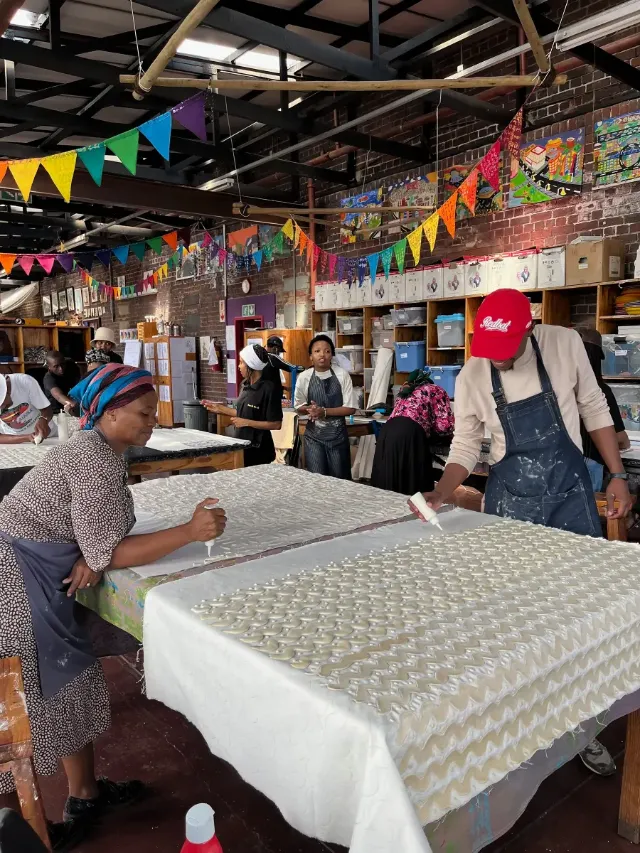
Imbali runs full- and part-time programmes, short courses and special projects in a range of creative arts and crafts fields. Our training standards are very high, and a large percentage of our graduates go on to successful careers in the creative industries. From the outset of their training, participants can generate income by selling their products through the Imbali Shop.
Our flagship programme is a two-year crafts training course, in which participants develop and hone their craft-making, design and production skills, along with business and marketing skills. This leads to independent and successful small business units for the production of contemporary and original South African craft. There is a dire need for training and skills development towards income generation and self-employment in South Africa. Jobs within the formal sector are limited, so the more young people empowered to create their own small businesses, the better.
Imbali is a not-for-profit organisation providing training to severely disadvantaged individuals, so we depend on funding for most of our activities.
- Flagship programme
- Two years, full-timeSubsidised, in Newtown
- Students
- About 40 a yearSelling in the shop from year one
- Reach
- Gauteng and beyondTeacher workshops in all nine provinces
Kind words
What people say
History
Over three decades of visual literacy
The Imbali Visual Literacy Project was founded as a project of Women for Peace in 1988, when a children's national art competition showed that children with little or no access to art at school demonstrated extremely poor perceptual skills. The project attempted to address this lack of basic visual literacy by developing strategies for training teachers with no arts backgrounds and working in poorly resourced schools. In 2018, this culminated in the publication of the Imbali Artbooks, 'Adventuring into Art', a series of eight books designed to provide art teachers with carefully structured and supported artmaking and looking activities, drawn from our 30 years of experience.
The arts now form part of the South African curriculum, thanks to educational reforms post 1994. However, most teachers assigned to teach creative art still have no formal arts training. Imbali therefore partners with provincial education departments to train art teachers in using the Imbali Artbooks, supported by funding from government, corporate and private donors. Teachers attend workshops and receive a set of the books for their school. Since 2019, we have been rolling out books and workshops to all nine provinces of South Africa.
In the late 1990s, the need for training for young people in skills towards income generation became urgent, and so the Imbali Crafts Training Programme was born. This has grown to become a fully accredited vocational training programme, focusing predominantly on textiles and ceramics. The programme develops participants into independent entrepreneurs, able to develop and design their own products and start their own crafts enterprises.
Imbali also runs shorter workshops and training programmes on request. These are tailored to meet the needs of the students.
-
1988
Yvonne Wilson founds Imbali as a project of Women for Peace.
-
Late 1990s
The Imbali Crafts Training Programme is born.
-
2006
Imbali begins supplying the Origins Centre shop.
-
2007
Registered as an accredited training provider with the CATHSSETA (1 June).
-
2010
Justine Watterson becomes director.
-
2014
Imbali begins supplying the Johannesburg Art Gallery shop.
-
2018
The Imbali Artbooks, 'Adventuring into Art', are published.
-
2019
Artbook workshops begin rolling out to teachers across all nine provinces.
How we are run
Organisational structure
- Imbali is overseen by a board of highly experienced and passionate individuals. As Imbali is an NPO, all board positions are unpaid and voluntary.
- The director oversees the organisation's daily operations and creative direction, and identifies new opportunities and partnerships.
- The project manager oversees all training and programmes, the development of written materials, and the organisation's accreditation status.
- A team of excellent facilitators (full and part-time) teach a range of specialist skills ranging across creative art, craft and business, as well as assisting with special projects and incubator work.
- Imbali also brings in a number of industry professionals who provide input on the development of new courses, programmes and products.
Status and accreditation
- Organisational status
- NPO 063-352-NPORegistered public benefit organisation PBO930031775, with Section 18A tax-exempt status
- Accreditation
- CATHSSETAAccredited training provider 613/P/000245/2014, registered 01/06/2007
- Vendor registrations
- Gauteng Shared Services CentreRegistered vendor. Central Supplier Database no. MAAA0823887
Help the next maker start
Donate
Visit the shop
Apply for the January intake Over 18 · two years · R400 registration plus a subsidised course fee